
A lot of people have been asking me what the scariest part of this move has been. I think what they’re really trying to understand is: how did we overcome that fear? I don’t have all the answers. I can only tell you my experience. So here it is, honest, imperfect, and raw. But hopefully someone out there relates.
The Scariest Part of Moving Abroad
For me, the scariest part of moving wasn’t the visa.
It wasn’t the flights.
It wasn’t the language.
It wasn’t even leaving family.
It was this:
Once we liquidated our house and our business, that was it.
That was everything.
A finite amount of money.
No reset button.
No hidden reserve.
No guarantee that more would be coming in.
If RISD hadn’t come through and agreed to contract work, there would have been no steady income. Just a slowly shrinking bank account and a ticking clock.
That reality sat heavy in my chest for months.
The Financial Risk We Took
When we were thinking about moving abroad from the US, the biggest question was whether we could actually afford it. We had already lost a lot of money supporting Busy B’s (a new business we were trying to get off the ground). The pressure to “get it right” the first time felt enormous. When the sale of our business fell through, it felt like the floor dropped out. We lost a lump sum we had been counting on and it felt like a free-fall. Luckily, thanks to the contract with RISD, we gained monthly income instead. The math shifted. The risk shifted. The uncertainty remained.
It was absolutely a leap of faith.
And I still don’t know if we did it the “right” way. In fact, I’m pretty sure we didn’t.
We didn’t have a perfect financial strategy.
We didn’t feel fully prepared.
We felt terrified. Possibly crazy. But we leapt anyway.
Our Cost of Living in Portugal vs. the US
And here’s what’s strange: our monthly expenses have gone down significantly since moving to Portugal.
And our quality of life has gone up just as significantly.
The cost of living here is much lower – so we need less money than we expected. This comparison by Numbeo.com shows that Providence, RI (where we lived in the U.S.) is significantly more expensive in EVERY SINGLE CATEGORY. Ok, well. Except local cheese. Common groceries are on average 98% more expensive in Providence than here in Loulé. Plus we spend less on online shopping (mostly because we can’t get anything delivered to our house – but that’s a story for a different post). I’m still going to sit down and calculate the numbers — what we spent monthly in the U.S. versus what we spend now — because I think that comparison will be helpful for families wondering if this is even possible. But what I already know is this:
We are spending less.
And living more.
Why Living on Less Was Worth It
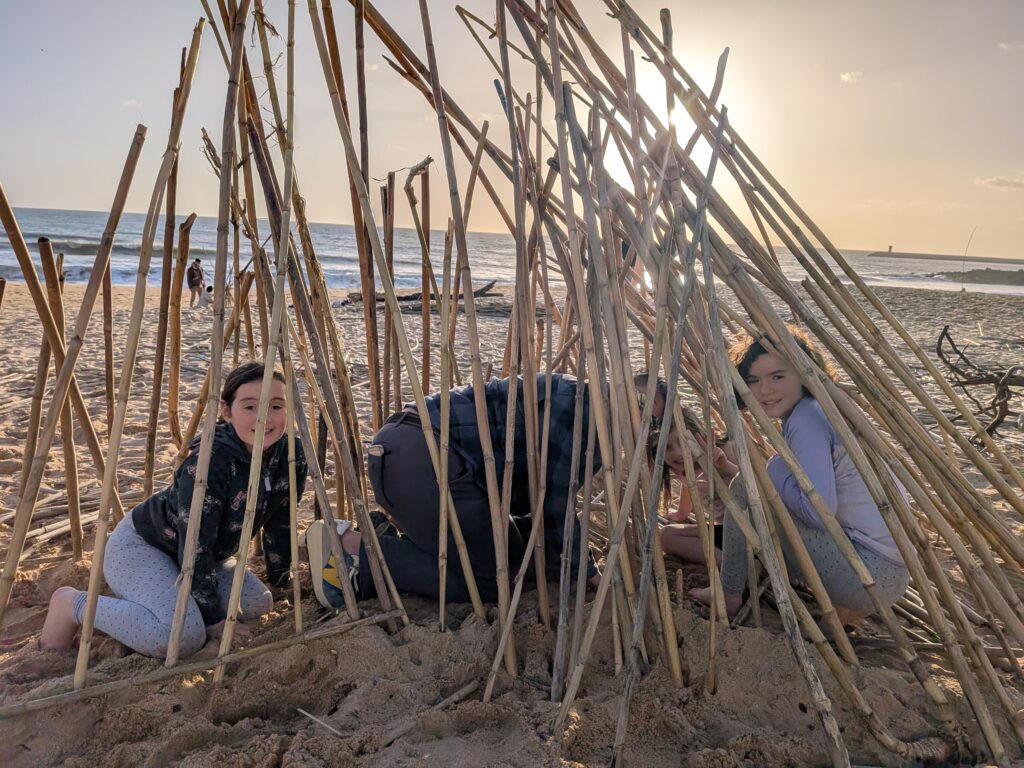
Last Saturday we packed bread, cheese, olive oil (fresh from a local friend’s olive grove), some bottles of wine and met some of our new friends at the beach. The winter rain has finally stopped and the sky was clear and sun was so warm. The kids ran barefoot until the most beautiful sunset formed over the ocean. No one was rushing home to prep for Monday. No one was calculating overtime hours in their head. No one was bracing.
And then the other night, just before bed, we were hanging around the living room. Nothing special. No big outing. No big milestone.
Rory, who has now perfected a British accent from being constantly surrounded by Brits, delivered some line in that flawless tone — I can’t even remember what it was — but her comedic timing was impeccable.
We laughed so hard our stomachs hurt.
Not polite laughter.
Not tired laughter.
The kind where you can’t breathe.
The kind where tears roll down your face.
The kind that leaves you sore the next morning.
And it’s been happening more and more.
At dinner.
In the car.
During random weekday afternoons.
With Stacey.
With the girls.
All of us tangled up in one ridiculous moment.
Was it all worth it?
When I try to summarize the difference between our old life and our life now, it comes down to three words:
We laugh more.
We still budget.
We still worry.
We still don’t have every long-term financial detail figured out.
But the constant fear, anxiety, stress, and horror we felt surviving daily soul-sucking life in the U.S. is gone – making laughter come more easily. We don’t have to work full-time to get (or afford) health insurance here, so we work less. I paint more. Read more. Stacey is woodturning again.
There’s more space.
More air.
More time.
More silliness.
I know we were fortunate to have equity in our home and business. I know not everyone has that runway. And I would never pretend this path is simple or universally available.
But I also know this:
You never feel like it’s enough.
You never feel ready.
You never feel certain.
At some point, you decide whether the life you’re building feels aligned — and whether the fear of staying outweighs the fear of leaping. (I go into detail about our motivation to leave in this post and this one.)
For us, it did.
We didn’t move because we had unlimited money.
We moved because we knew a different way of living was possible – away from fascism, violence, and fear — and we were willing to adjust our lifestyle to find it.
Living on less doesn’t feel like deprivation.
It feels like recalibration.
And right now, recalibration looks like this:
A nine-year-old with a killer British accent.
A living room full of laughter.
Saturday nights at the beach with friends.
And the kind of joy you can’t itemize on a spreadsheet.
We don’t know exactly what the next five years will look like.
But we laugh more.
And for now, that feels like a pretty solid return on investment.